Google Summer of Code 2025 Results
The Google Summer of Code (GSoC) program focuses on engaging new developers worldwide with open source software development. Google…

The Google Summer of Code (GSoC) program focuses on engaging new developers worldwide with open source software development. Google sponsors contributors to work with a mentoring open source organization on a 12-week programming project during the summer. Over the past 20 years, more than 20,000 contributors have participated in Google Summer of Code.
In 2025, Dart participated as a mentoring organization in Google Summer of Code for a sixth consecutive year. This year we received well over a 100 project proposals from prospective participants around the world. Today, we spotlight some of the projects we mentored this summer. The contributors describe their projects in this post.
Custom iOS context menu items
#By Jing Shao
A key goal in mobile app development is delivering a truly native experience. Before this project, Flutter apps on iOS had a major limitation — developers couldn’t add custom actions to the native iOS context menu. During GSoC 2025, I successfully implemented custom context menu support for Flutter iOS, which significantly enhanced Flutter apps’ interaction capabilities on iOS.
This project created the new
IOSSystemContextMenuItemCustom API, allowing
developers to easily add custom actions to the native iOS
menu through TextField’s
contextMenuBuilder property; developers can add
menu items with custom titles and callbacks. The
implementation bridges Flutter with the native iOS UIMenu
system, ensuring custom items integrate seamlessly with
standard iOS menu options (copy, paste) while maintaining
the native look and feel.
With this improvement, Flutter developers can now build more expressive and feature-rich applications. This work marks an important step forward for Flutter in delivering excellent cross-platform native experiences, giving developers powerful tools to build outstanding apps. For more details, check out my technical blogs and PRs on GitHub. Feel free to reach out for any questions! I would like to thank my mentors Justin and Huan for their invaluable guidance and support throughout this project.

Below is an example showing custom menu items like Clear Text, Add Heart ❤️, and Uppercase alongside standard iOS menu items in the native context menu.
Dart TUI framework
#By Gedion Ezra
Before this project, Dart developers who wanted to build interactive terminal applications often had to switch to Rust, Go, or Python. There was no mature text-based, user-interface (TUI) framework in Dart, limiting developers to GUIs or static CLI tools. As part of GSoC 2025, we built Pixel Prompt, a terminal UI framework inspired by Flutter’s declarative, component-based approach. Pixel Prompt allows developers to create dynamic interactive apps entirely in Dart.
Pixel Prompt introduces a Component to a ComponentInstance
model, inspired from Flutter’s layered architecture that
maps a widget (in the widget layer) to an element layer and,
in turn, to the RenderObject layer. Components describe the
UI declaratively while
ComponentInstances manage state layout and
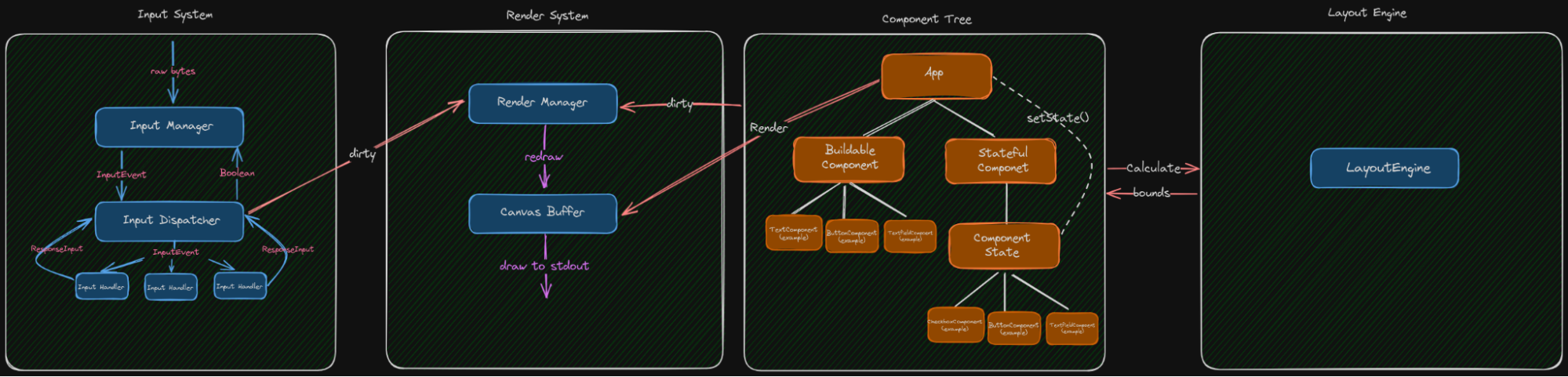
rendering. Check out a simplified version of the
architecture:
The framework supports stateful and stateless components, input handling, and optimized rendering with double buffering and ANSI diffing. This improves performance by minimizing terminal redraws and enables reliable golden testing with a virtual terminal interpreter.
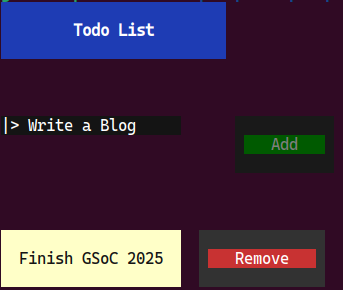
To give a visual sense of what Pixel Prompt can achieve, screenshots of some demo are available below. These demonstrate the declarative layout, interactive components, and real-time updates that the framework supports, showing that Dart can now power fully interactive terminal applications without leaving its ecosystem.
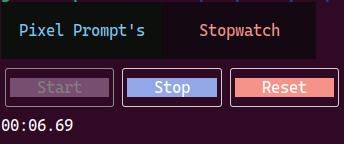
While Pixel Prompt already enables building core terminal
applications, there’s more to come: the support for complex
components like
TextArea and Tables, a flex-like
layout system, a dedicated animation API, and a visual
debugger are planned for future contributions. Interested
developers can explore open issues and contribute on the
pixel_prompt
repo.
TestGen — LLM-based test generation tool
#By Amr Ahmed
The primary goal of TestGen, an experimental project that automates unit test generation for Dart, is to improve test coverage by generating test cases that specifically target uncovered lines in the codebase. By leveraging large language models (LLMs) to produce meaningful tests, TestGen reduces the manual effort required to write tests, helping developers achieve higher coverage and improve code quality.
One of the main challenges in using LLMs for automated test generation is deciding how much code context to give the model. For example, if a function needs testing and we provide the entire file as context, the LLM might get overwhelmed and produce irrelevant or inaccurate tests. If we provide only the function itself, the model can miss important dependencies inside the function, leading to incomplete or broken tests. To solve this, TestGen uses the Dart analyzer to parse the whole codebase into Declarations, which are classes that represent a code construct like a function, variable, class, or mixin**.** After parsing, it constructs a dependency graph across these declarations, which shows exactly the pieces of code on which a given declaration depends. This is done by traversing the Abstract Syntax Tree (AST) of a given declaration and recording its dependencies during the visit. Using this graph, TestGen can provide the LLM with only the ****relevant context (context-aware prompting) at a configurable depth, helping it generate accurate and focused tests without extra noise.
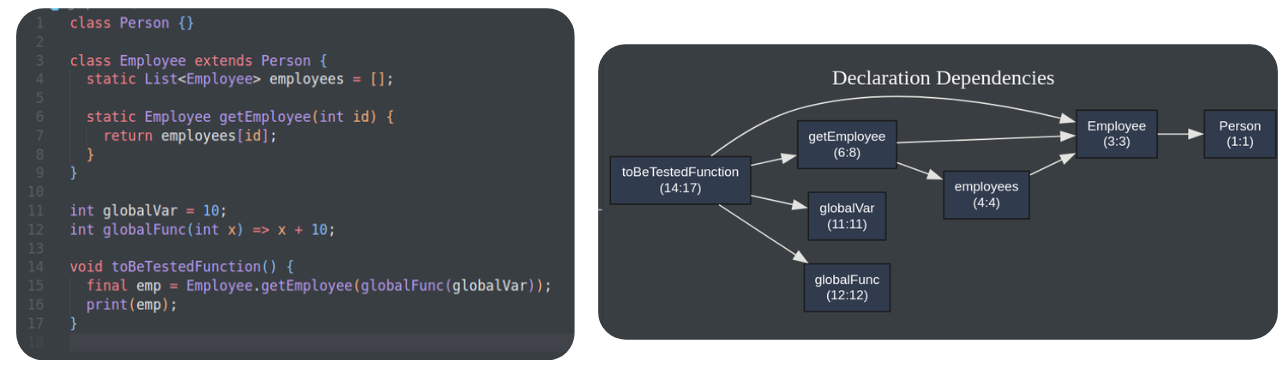
To make test generation effective, TestGen integrates with
package:coverage
to automatically detect which parts of the code are not yet
tested and target those. The tool connects to
Gemini models through
package:google_generative_ai,
using variants like gemini-2.5-pro, gemini-2.5-flash, and
gemini-2.5-flash-lite
to generate test cases. These tests then go through a
validation and feedback loop, where they are executed and
checked for errors. If issues are found, the errors are fed
back into the LLM so it can refine the output, making the
final tests more accurate and reliable.
There is more to come for this package, including new features, improved testing, and adding support for Flutter projects. You can check the current list of issues on the dart_testgen repo. For a sample of how the generated prompts look, see the default-prompt example. More details about the project are available in the full GSoC report.
LLM-powered translation of Android (Java/Kotlin) docs into Dart using JNIgen bindings
#By Marshelino Maged
Android libraries and utilities are typically documented with Java/Kotlin code snippets. While JNIgen makes it possible to generate Dart bindings for these libraries, writing Dart code against the bindings can be challenging due to syntactic and structural differences between the languages. This means developers cannot directly reuse the many Java/Kotlin examples found in official Android documentation and tutorials. The native_doc_dartifier project was created to address this gap by automatically translating Java and Kotlin snippets in Android documentation into their Dart equivalents.
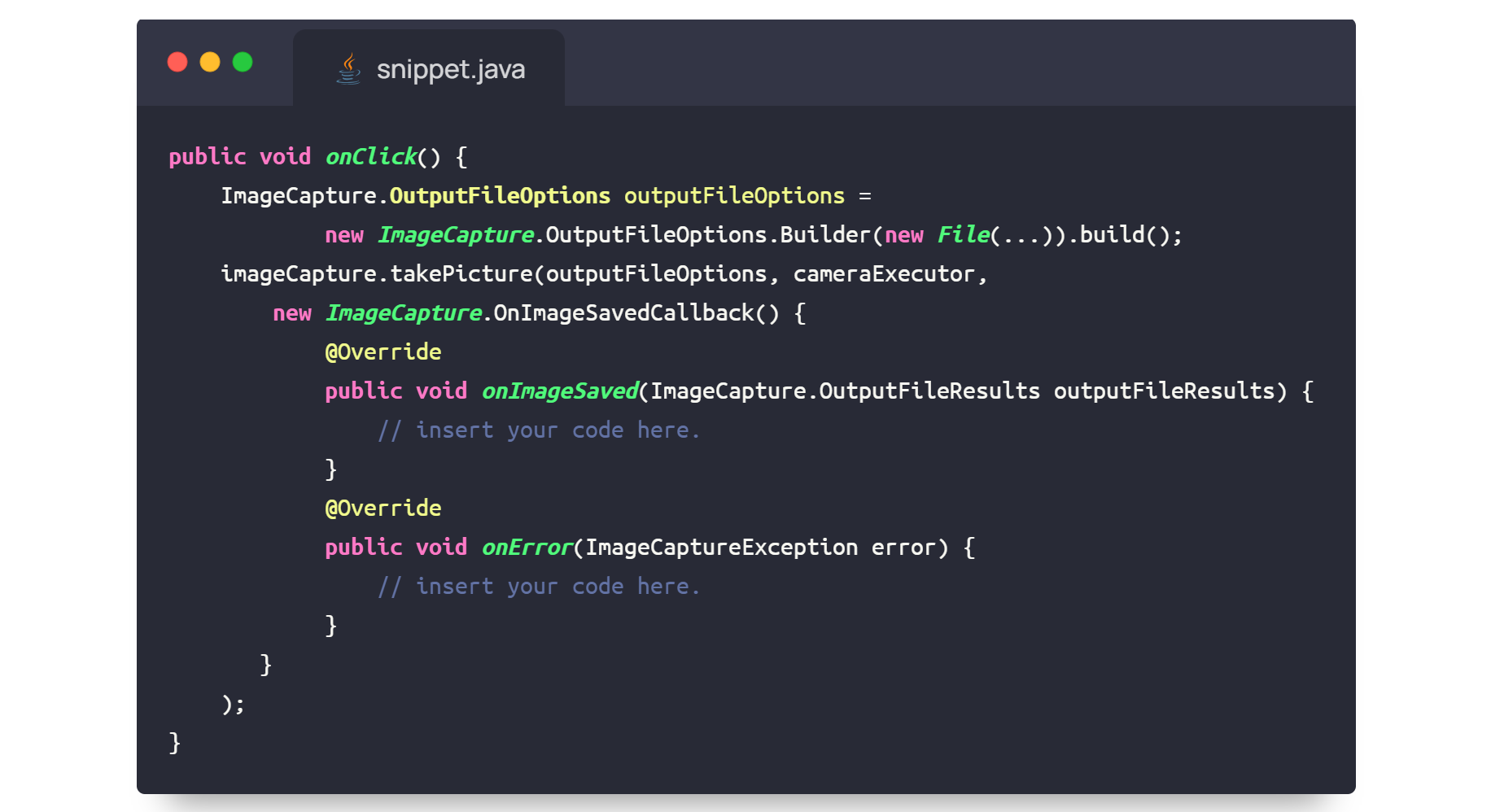
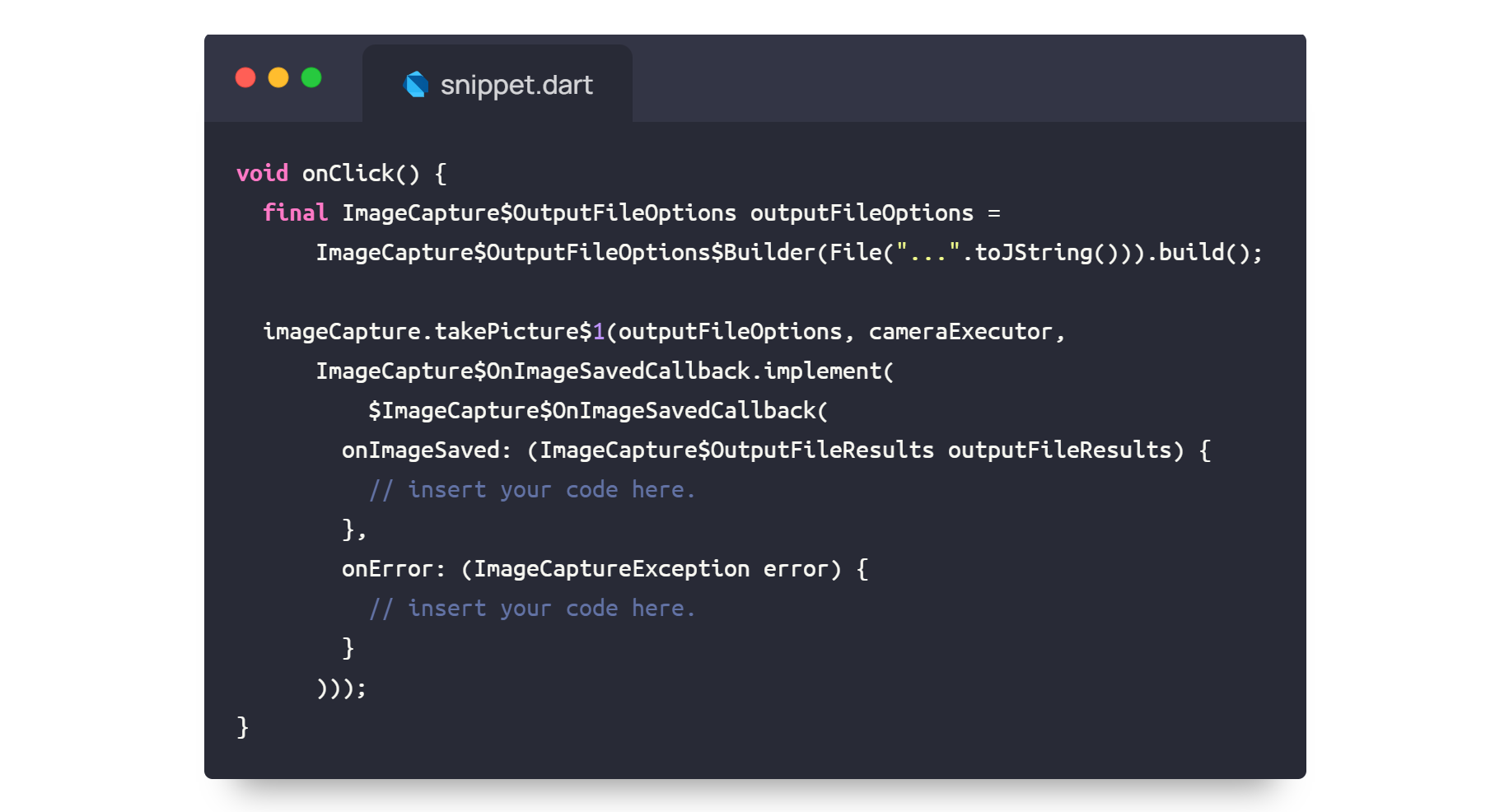
The project builds on JNIgen, which generates Dart bindings
for Java and Kotlin APIs through foreign function interface
(FFI). Because Java and Dart differ in both syntax and
semantics, a direct translation is not sufficient. For
example, Java supports method overloading while Dart does
not, leading JNIgen to disambiguate bindings with renamed
methods such as
add$1 and add$2. To generate
accurate Dart code, the translation model must take these
binding conventions into account rather than relying on
surface-level conversion.
A major technical challenge was scale: bindings for Android libraries often include hundreds of thousands of lines of boilerplate code, far exceeding the input limits of even the largest language models (currently 1M token). To address this, the project introduced Abstract Syntax Tree (AST) extraction, which reduces the bindings to their public API surface — resulting in about 6% of the original size — while preserving critical information. This was combined with retrieval-augmented generation (RAG), where each class’s AST is stored separately and only the most relevant classes are retrieved based on the snippet being translated.
By combining
AST extraction with retrieval-based context
selection, native_doc_dartifier
is able to produce Dart translations that are both accurate
and aligned with the generated bindings, while remaining
efficient within LLM context constraints. The result is a
practical solution that reduces friction for Dart developers
working with Android documentation and strengthens
interoperability between the Java/Kotlin and Flutter
ecosystems.
Since translations are generated by an LLM, occasional errors can occur when compiling the produced Dart code. To improve reliability, the system incorporates a feedback loop: compilation errors are returned to the LLM for several iterations, allowing it to refine and correct the translation until a working version is produced. This iterative approach further increases the robustness of the generated examples.
For more information, visit the native_doc_dartifier repo.
Translate TS Declarations to Dart JS Interop Interfaces
#By Nikechukwu Okoronkwo
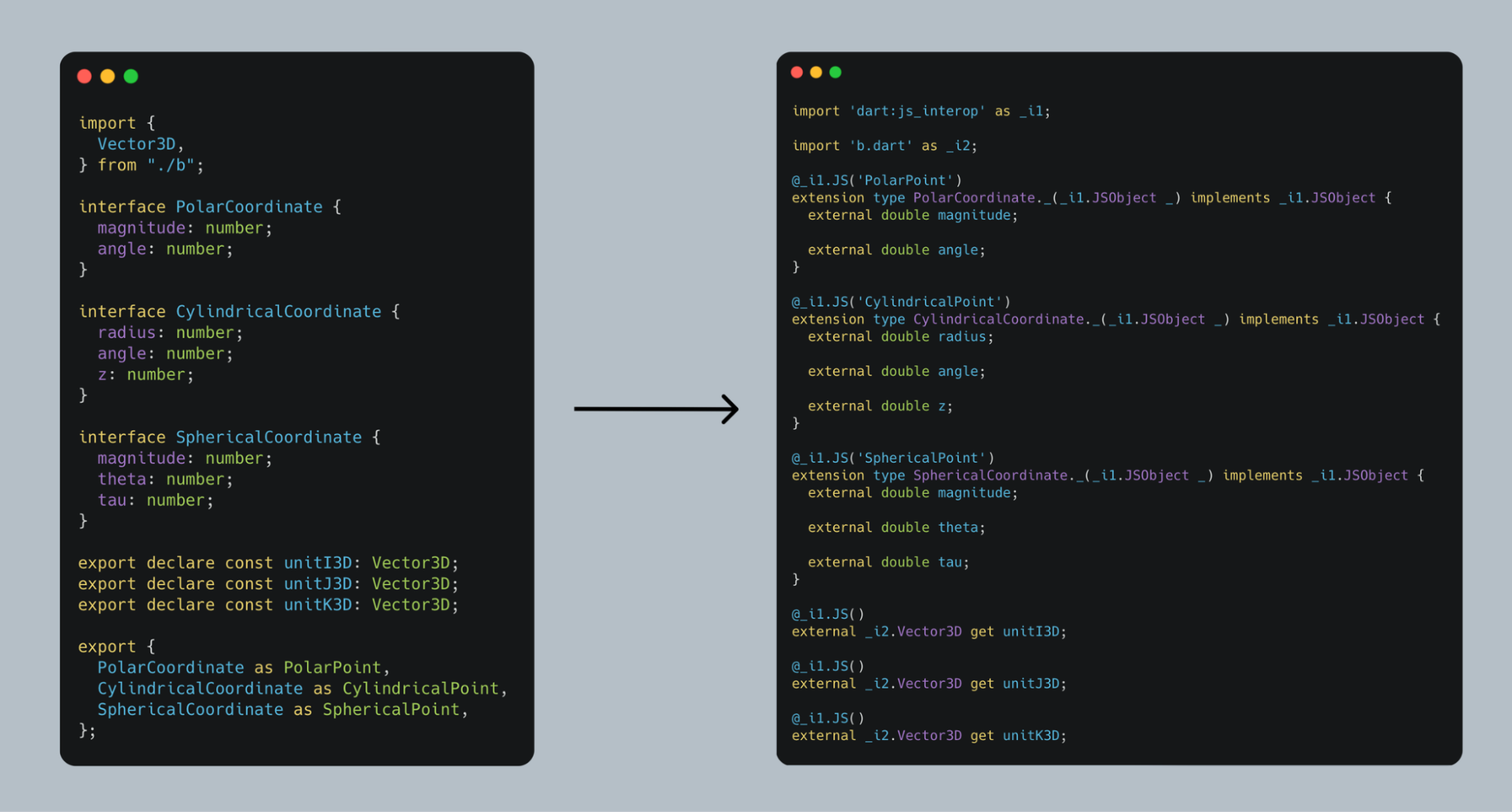
Dart provides powerful interop with JavaScript through
dart:js_interop, which can be used to interface
with code written in JavaScript. However, writing bindings
for large libraries and packages can be time-consuming and
error-prone. To solve this, we created the JS Interop
Generator. It automatically generates Dart wrappers from a
TypeScript declaration file
(.d.ts). This helps with Dart’s adoption on the
web and allows Dart and Flutter developers to more easily
leverage the vast ecosystem of JS libraries from NPM and
elsewhere.
The generator works by parsing a .d.ts file and
transforming its TypeScript declarations into their Dart
equivalents. The declarations are generated based on how
Dart interops with JS, ensuring correctness in terms of
interop implementation with the JS code represented by the
TS declaration code, as well as closeness to the TS
declaration’s representation of the code, where possible.
It supports a wide range of TS features, including
variables, functions, enums, classes, interfaces,
namespaces, and type-aliases. The generator produces
equivalent Dart representations of TS types and leverages
existing types from
dart:js_interop and
package:web when possible. This includes
support for advanced TypeScript features like anonymous
objects, anonymous closures, unions, merged types, and
typeof / keyof.
You can see many examples in the integration test suite. We’ve already used the generator to successfully create bindings for popular packages like nanoid and uuid. For more details on this, see the generator test results.
The project is available in the
web_generator package in the
web repo. You
can try it out by running the
bin/gen_interop_bindings.dart script. If you
encounter any issues or bugs, feel free to file an issue
and/or contribute!
More from Dart

Dart in Google Summer of Code 2026
We’re excited to announce that the Dart project will mentor contributors for the seventh time in Google Summer of Code 2026!


Dart in Google Summer of Code 2025
We’re excited to announce that the Dart project will mentor contributors (for the sixth time!) in Google Summer of Code 2025.