Dart 2.17: Productivity and integration
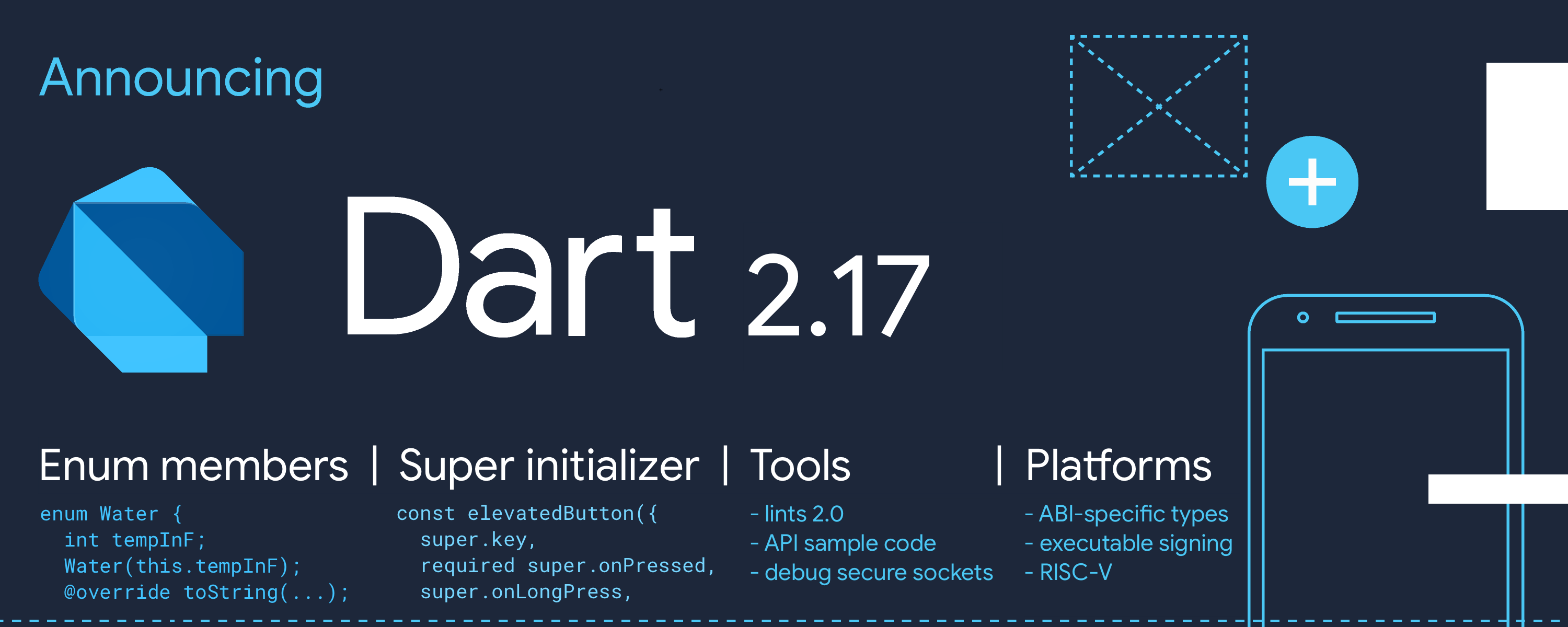
Language features. Productivity tools. Deeper & broader platform integration.

Today at
Google I/O, we announced a new Dart SDK, version 2.17. This release
builds on our core themes of leading productivity and
platform portability. It offers new language features: enums
with member support, improved parameter forwarding to super
classes, and more flexibility for named parameters. We have
improved tools with a new major version of
package:lints — our tool support for checking
Dart code against our best practices — and a broad update of
core library API documentation with rich code samples. For
improved platform integration we have new templates for
using dart:ffi (native C interop) in Flutter
plugins, experimental support for RISC-V processors, and
support for signing macOS and Windows executables.
New language features for improved productivity
#We constantly evolve the Dart language to make you more productive — both by adding new features and by making improvements to existing features. Dart 2.17 adds major new support for members on enums, refines how you can use named arguments in constructors, and makes code for forwarding parameters to superclasses much less verbose and repetitive.
Enhanced enums with members
#
Enums are great for representing a discrete set of states.
For example, we might model water as
enum Water { frozen, lukewarm, boiling }. But
what if we want to add some methods on the
enum — for example, to convert each of the
states to a temperature, and support converting the
enum to a String? We could perhaps
use extension methods to add a
waterToTemp() method, but we’d have to be
careful to keep that in sync with the enum. For
the String conversion we’d prefer to override
toString(), but that hasn’t been supported.
With Dart 2.17 we now have general support for members on enums. That means we can add fields holding state, constructors that set that state, methods with functionality, and even override existing members. Many of you have been requesting this capability; it was our third highest voted issue in the language tracker.
For our water example, we can add an int field
holding the temperature and a default constructor that takes
an int:
enum Water {
…
  final int tempInFahrenheit;
  const Water(this.tempInFahrenheit);
}
To ensure the constructor is called when the
enum is created, we need to invoke it for each
enum value:
enum Water {
  frozen(32),
  lukewarm(100),
  boiling(212);
…
}
To support the conversion to String, we simply
override toString, which
enums inherit from Object:
[@override](http://twitter.com/override)
String toString() => "The $name water is $tempInFahrenheit F.";
And with that, you have a complete enum that
can be easily instantiated and you can invoke methods on:
void main() {
  print(Water.frozen); // Prints “The frozen water is 32 F.”
}
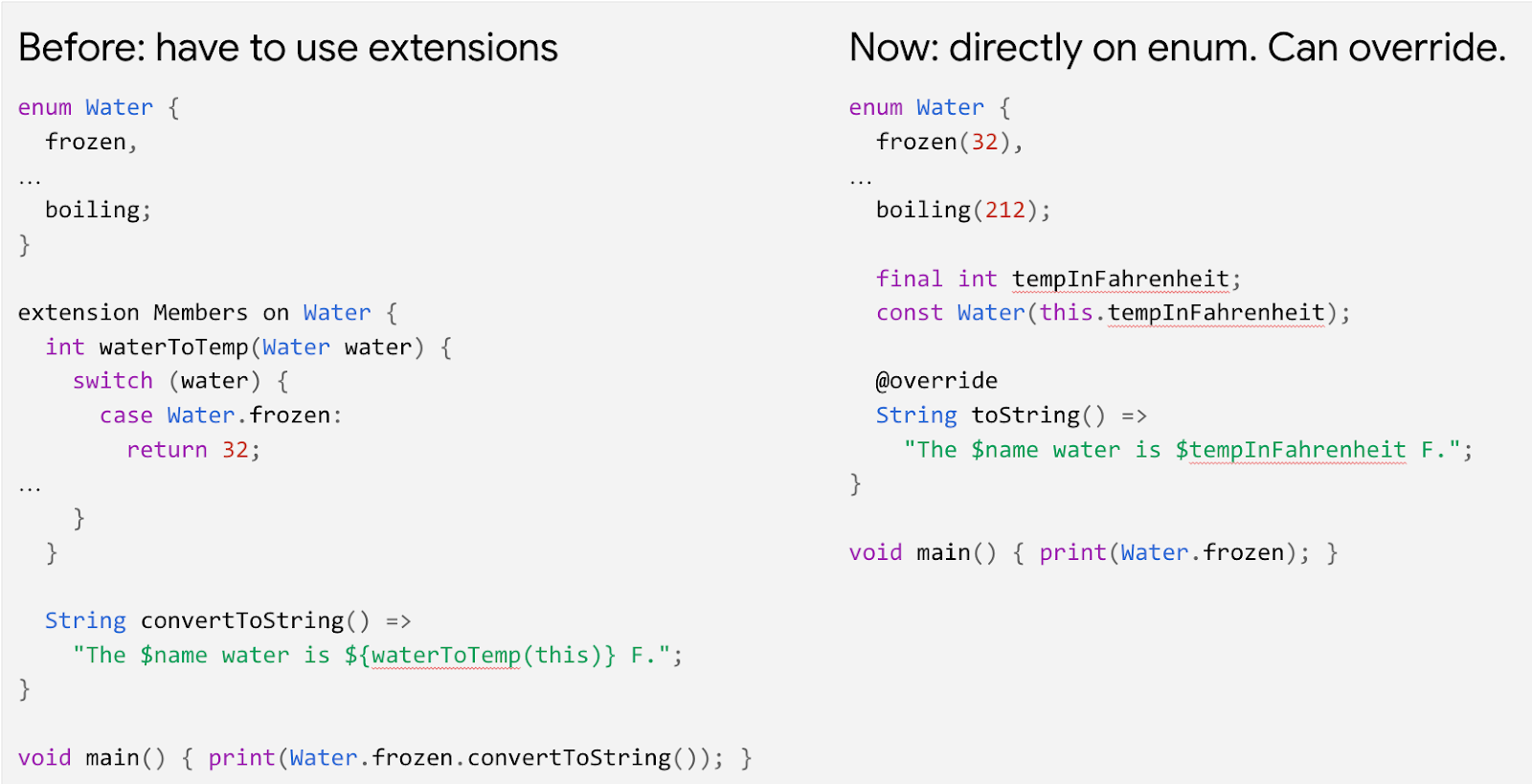
A complete example of these two approaches is illustrated below; we find the new Dart 2.17 version much easier to read and maintain.
Super initializers
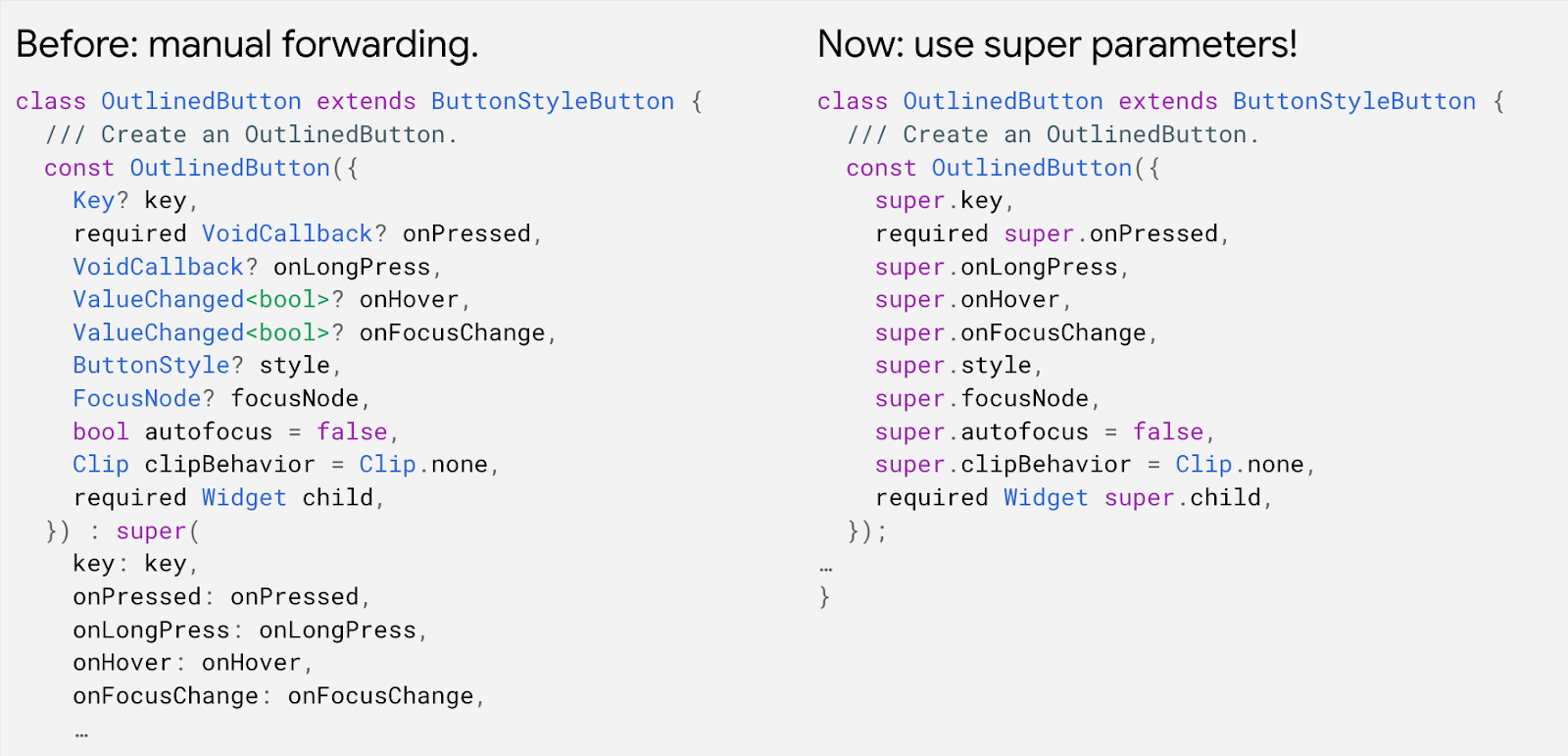
#When you have a class inheritance hierarchy, a common pattern is to pass some constructor parameters to the constructor of the superclass. To do that, the sub-class needs to 1) list each parameter in its own constructor, and 2) invoke the super constructor with those parameters. That leads to boilerplate code: lots of repetition, making the code harder to read and more bothersome to maintain.
Several Dart community members helped make this happen. GitHub user @roy-sianez filed a language issue regarding this about half a year ago; suggesting something similar to what GitHub user @apps-transround had suggested earlier: that we could perhaps resolve this by introducing a new construct to express that a parameter was specified in the super class. We thought that was a great idea, so this has been added to Dart 2.17. As you can see from the following example, this is especially relevant for Flutter widget code. In fact, when we applied the new feature to the Flutter framework, we saw a total reduction of nearly two thousand lines of code!
Named args everywhere
#
Lastly, we’ve refined how named arguments work when you
invoke a method. Previously, these had to appear last in the
list of arguments to the method. This was annoying in cases
where you’d prefer to place a positional argument last to
make the code more readable. For example, see the following
invocation of the
List<T>.generate constructor —
before, the growable argument had to be placed last, making
it easy to miss below the large positional argument
containing the generator itself. Now you can order them as
you prefer, allowing you to place the small named arguments
first and the generator last.
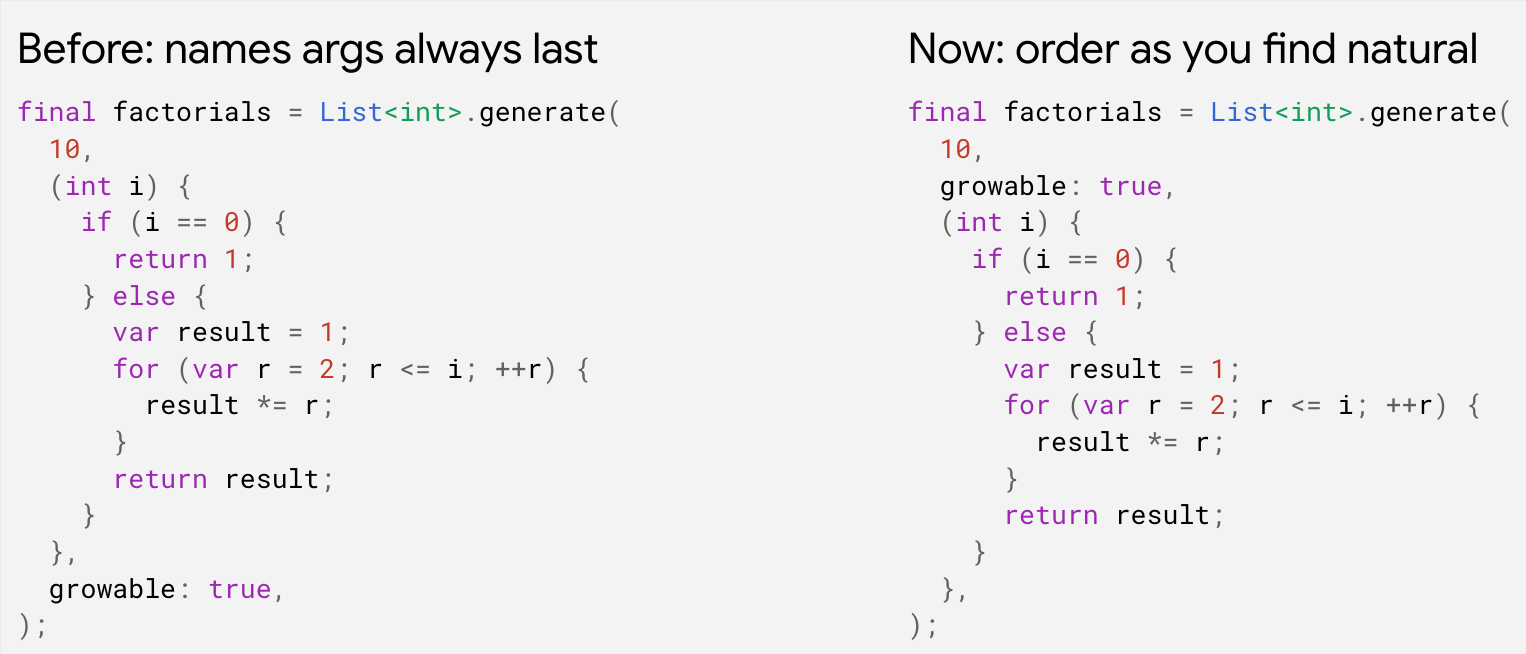
For further examples of these three features in actions, see our updated samples for enums, super initializers, and named parameters.
Productivity tools
#Continuing the productivity theme, we have several improvements in our core tools.
In Dart 2.14 we introduced package:lints, which
works with the Dart analyzer to help you write Dart code
that prevents errors and uses a canonical style enabling
more effective code reviews. Since then a number of new
lints have been made available in the analyzer, which we’ve
carefully triaged and from that selected
ten new lints
for all Dart code, and
two new lints
specifically for Flutter code. These include lints for
ensuring your imports are included in your pubspec file,
preventing the misuse of null checks on type parameters, and
ensuring a consistent style for child properties. You can
upgrade to the new lints with a simple command:
-
For Dart packages:
dart pub upgrade —-major-versions lints -
For Flutter packages:
flutter pub upgrade —-major-versions
                          flutter_lints
SecureSockets are commonly used to enable TCP sockets
secured with TLS and SSL. Before Dart 2.17, debugging these
sockets during development was tricky, as there was no way
to inspect the secure data traffic. We’ve now added support
for specifying a
keyLog file. When specified, a line of text in
the
NSS Key Log Format
is appended to the file when new TLS keys are exchanged with
the server. This enables network traffic analyzer tools
(such as
Wireshark) to decrypt the content sent through the socket. For
details, see the API docs for
SecureSocket.connect().
API documentation generated by the
dart doc tool is a critical asset to most Dart
developers learning new APIs. While our
core library APIs
have long had rich textual descriptions, many developers
have told us they prefer to learn APIs by reading sample
code that uses the API. With Dart 2.17, we’ve completely
overhauled all major core libraries, adding sample code to
the top 200 most viewed pages, so they now have
comprehensive sample code. As an example, compare the
documentation for dart:convert in
Dart 2.16
with the updated page for
Dart 2.17; hopefully this makes the documentation much easier to
consume.
Productivity gains come not only when we add new features to
our platform, but also when we clean up our stack and remove
features that are no longer used. This helps keep our
surface area small, which is critical especially to new
developers. Towards this, we’ve removed
231 lines of deprecated code
from the dart:io library — if you are still
using these deprecated APIs, you can upgrade to their
replacements with
dart fix. We’ve also continued our effort to remove
deprecated Dart CLI tools, this time removing the dartdoc tool (use
dart doc instead), and pub tool
(use dart pub or flutter pub).
Broadening our platform integration and support
#A second core theme is platform integration and support. Dart is a true multi-platform language. While we already support a wide range of platforms, we’re constantly evolving to ensure that you can deeply integrate with each supported platform, and also to support emerging platforms.
Dart FFI — our core mechanism for
interop with C/native code
— is a popular way of integrating Dart code with existing
native platform code. On Flutter, this can be a great way to
build
plugins
that use native APIs from the host platform (such as Windows
win32 APIs). In Dart 2.17 and Flutter 3, we’ve added
templates to the flutter tool so you can now
easily create FFI Plugins that have a Dart API backed by
dart:ffi calls into native code. For details,
see the updated
developing packages and plugins
page on flutter.dev.
To enable use of FFI on platforms that have types specific
to their ABI (application binary interface), FFI now supports ABI-specific types. For example, you
can now use
Long
(long
in C) to correctly represent a long integer with an
ABI-specific size, which might be 32-bit or 64-bit depending
on the CPU architecture. For the full list of supported
types, see the list of “Implementers’’ in the
AbiSpecificInteger
API page.
When deeply integrating with native platforms using Dart
FFI, you sometimes need to align the cleanup of memory or
other resources (ports, files, and so on) allocated by Dart
and the native code. This has historically been very tricky,
as Dart is a garbage collected language that automatically
handles cleanup. Dart 2.17 solves this by introducing the
concept of a Finalizer, which includes a
Finalizable marker interface for “tagging”
objects that shouldn’t be finalized or discarded too early,
and a NativeFinalizer class that can be
attached to a Dart object to provide a call-back run when
the object is about to be garbage collected. Together these
allow for running cleanup code in both native and Dart code.
For details, see the description and example in the API
documentation for
NativeFinalizer, or the documentation for
WeakReferences
and
Finalizer
for similar support in regular Dart code.
Our support for compiling Dart to native code is a core
enabler of making Flutter apps have great startup
performance and fast rendering. A second use case is the
ability to compile Dart to executables with
dart compile. These executables can run standalone on any machine
without needing the Dart SDK to be installed. Another new
capability in Dart 2.17 is support for
signing of executables, which enables deployment on Windows and macOS where
signing is often required.
We’re also continuing to broaden our set of supported
platforms by staying at the forefront of new emerging
platforms.
RISC-V is a new
innovative instruction set for processors. RISC-V
International, a global non-profit organization, owns the
RISC-V specification, making the instruction set free and
open. This is still an emerging platform, but we’re excited
about its potential, so our
2.17.0–266.1.beta Linux release (or later from
our
beta channel)
includes experimental support for it. We’d love to hear your
feedback, so please
file an issue
or
post
about your experience!
Get started with Dart 2.17!
#We hope that today’s Dart 2.17 release excites you, improves your productivity, and enables even more platform integration for your apps. To get started, you can directly download the Dart 2.17 release, or get it embedded as part of today’s Flutter 3 SDK release.
We also invite you to check out the new content we’ve made available for Google I/O!